



Online Event: AI and disinformation: What’s next?

- This event has passed.
Online Event: AI and disinformation: What’s next?
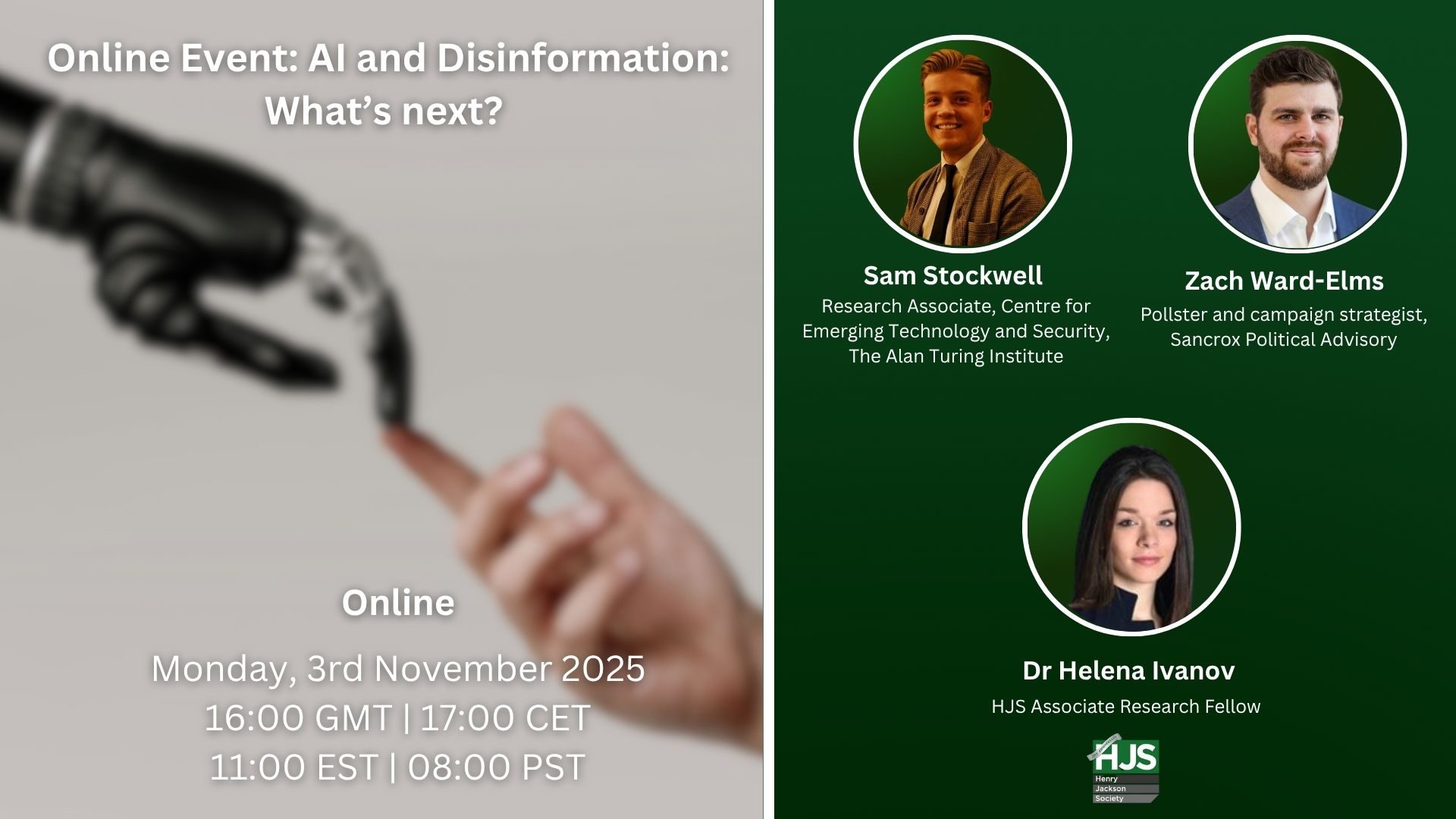
Please note this event will be online. To register for the zoom session, please CLICK HERE.
Artificial intelligence is transforming the way information is created, shared, and consumed – and with it, the threat landscape for democracies worldwide. 2025 has seen the rapid rise of AI-driven disinformation, from deepfakes to synthetic news, deployed by both state and non-state actors to manipulate public opinion and undermine trust. This session will examine the most striking examples of AI-enabled disinformation over the past year, explore how governments, tech companies, and civil society have responded, and assess the risks that lie ahead. With elections, conflicts, and global rivalries on the horizon, the discussion will ask: how prepared are we for an age in which truth itself can be manufactured at scale and what does this mean for the future of democracies?

Sam Stockwell is Research Associate at the Centre for Emerging Technology and Security (CETaS), which sits within The Alan Turing Institute. His research focuses on how AI is affecting the online information ecosystem, particularly in relation to mis/disinformation, moderating harmful content, and election interference. He also conducts research on challenging issues at the intersection of privacy and safety trade-offs, such as the use of biometrics in law enforcement and lawful access proposals for criminal investigations on end-to-end encrypted networks.

Zach Ward-Elms is a pollster and campaign strategist at Sancrox Political Advisory. He has worked on over a dozen election campaigns, including as Director of Research and Messaging for the New Zealand National Party during their 2023 landslide election victory.

Dr Helena Ivanov
Dr Helena Ivanov is an associate research fellow at the Henry Jackson Society. She recently completed a PhD in International Relations at the London School of Economics and Political Science. Her research focuses on the relationship between propaganda and violence against civilians. In her thesis, Helena examined the role propaganda played during the Yugoslav Wars and produced a model for studying propaganda which details the key phases, functions, discourses, and techniques of propaganda (the model itself is applicable to other contexts). Additionally, Helena also served as a Manager at the Centre for International Studies at the LSE. Prior to her PhD, Helena completed an MPhil in Political Theory at the University of Oxford, and holds a BA in Politics from the University of Belgrade.

