



In late February 2022, just three weeks after Beijing and Moscow declared a bilateral partnership with “no limits” in scope, Russia launched its full-scale invasion of Ukraine. At first, China’s support for Russia’s war was measured and cautious: in the initial weeks, Beijing appeared to distance itself from the conflict, emphasising neutrality and calling for talks. Yet over time, China’s assistance became increasingly pivotal for the Kremlin, gradually expanding across economic, technological, diplomatic, and political domains.
British politicians, including senior government ministers and members of parliament, have raised persistent concerns about China’s support for Russia’s war in Ukraine. In October 2024, during a visit to Beijing, then Foreign Secretary David Lammy urged his Chinese counterpart to investigate and stop Chinese companies from supplying Russia’s military. He warned that such support risks damaging China’s relations with Europe while sustaining Russia’s war effort. Lammy has continued to raise these concerns in parliamentary statements and meetings.
Similar warnings have been voiced across the European continent. Ursula von der Leyen and Kaja Kallas have been among the most outspoken European Union leaders in criticising China’s support for Russia. In April 2026, Finnish Foreign Minister Elina Valtonen went so far as to declare that China’s close ties with Russia should be a “disqualifying factor” in Beijing’s bid to open free-trade negotiations with the European Union, a statement that illustrated both apprehension about the close Sino-Russian ties and the fragility of European unity: decisions would require the support of all twenty-seven member states. Valtonen was, in effect, announcing a veto connected to China’s support for Russia. Yet her intervention also highlighted how divided the bloc remains on China, given the depth of ties that countries such as Spain and Germany maintain with Beijing.
Overall, Beijing’s reluctance to condemn Russia’s invasion, and its refusal to respond positively to European requests that it restrain President Vladimir Putin, have further strained relations with Ukraine’s supporters and deepened political distrust.
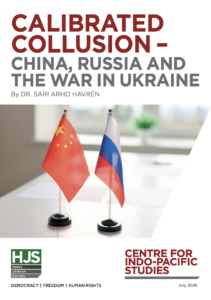
READ THE REPORT HERE
The relationship between Beijing and Moscow since the full-scale invasion of Ukraine in February 2022 is often regarded as a matter of temporary wartime convenience – an arrangement of mutual advantage which a ceasefire, a change of government in Moscow, or renewed Western engagement might dissolve. Dr Sari Arho Havrén’s paper demonstrates with admirable rigour that the opposite applies.
China’s support for Russia’s war effort has been carefully calibrated, sustained and expanded. It is not the improvisation of opportunists, but the product of decisions taken at the highest levels of the Chinese Communist Party. China’s support results in energy revenues, in dualuse components reaching the battlefield via concealed supply chains, and in diplomatic cover for Russia at the United Nations and elsewhere. We should harbour no illusion that Beijing is a neutral bystander in the war against Ukraine.
As well as charting China’s pro-Russian initiatives, Dr Arho Havrén asks a harder question: what does China gain from all this, beyond the immediate commercial and energy dividends? Her answer is that Beijing is using the war, and the strains it has placed on the Western-led order, to advance a parallel architecture of global governance in which Russia’s dependency is a structural feature rather than an incidental one. Her thesis deserves close attention from our Government and our allies.
Cold War Sino-Soviet estrangement no longer applies. Nixon and Kissinger a genuine rupture between Moscow and Beijing to exploit, but no comparable divergence now exists. Nor, for the foreseeable future, is one likely to emerge. This has direct implications for British policy, which the author sets out with admirable clarity: for example, sanctions enforcement is inadequately applied against the intermediaries and the financial techniques which sustain illicit trade with Russia. On the other hand, our dealings with the countries of the Global South must recognise those aspects of the Chinese propaganda narrative which exploit hypocrisy, or worse, in the record of the West.
The outcome of the Kremlin’s bloody conflict in Ukraine will have vast consequences for the future security of Europe. An erratic and unreliable US leadership has put the stability of Western deterrence policy in greater jeopardy than at any time since the foundation of NATO. We need clarity about Chinese motives and methods if we are successfully to assess and navigate this complex and hazardous geopolitical era. By commissioning such highquality analyses as Dr Arho Havrén’s paper, the Henry Jackson Society continues to provide Parliament and the public with the insight we need for the trials ahead.
– The Rt Hon Sir Julian Lewis MP

