




by Dr John Hemmings
Last week, while meeting with President Donald Trump, Chinese President Xi Jinping railed against Japan’s “remilitarization”, in what has been called a “heated” diatribe. Demetri Sevatopulo, the FT correspondent in Washington was first to get the scoop from US officials returning from Beijing and broke the story over the weekend.
According to Christopher Johnstone, a former White House and Department of War official, “Xi’s lack of self-awareness is remarkable. His own actions are accelerating the emergence of a much stronger Japan.” Rush Doshi, President Biden’s China Director in the National Security Council, simply posted a graph on X showing the rise of Chinese and Japanese defence spending between 2000 and 2021. The graph shows the reality: China’s defence budget in 2000 was $30bn; by 2025, it had risen to $336bn.
According to the SIPRI Military Expenditure Database, it is the longest unbroken stream of defence rises – 31 years in all. In 2025, China spent more on defence the next 22 Indo-Pacific countries combined (excluding the US).
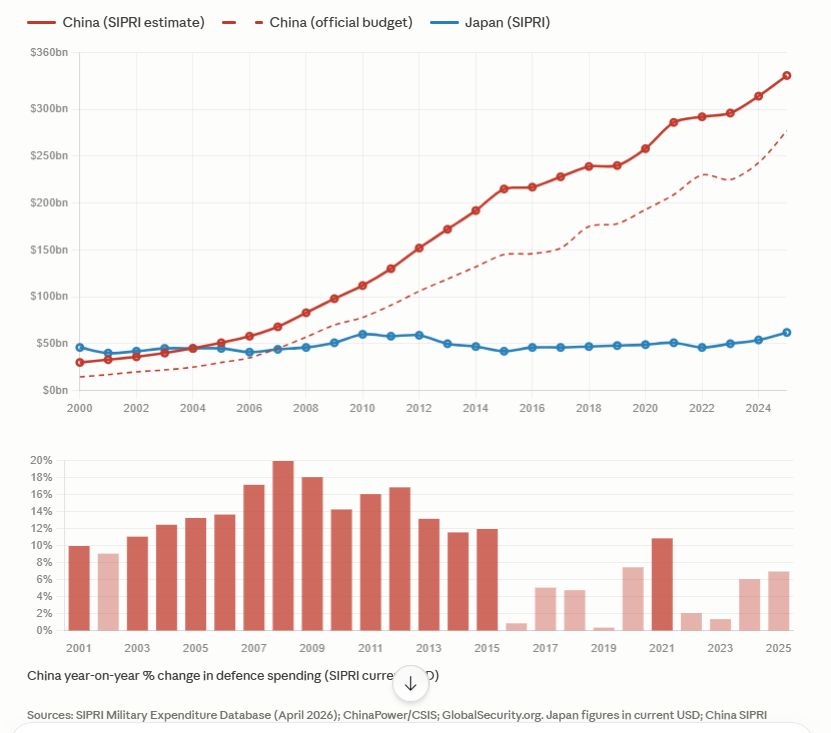
As the graph above – and Doshi’s X graph – reveal, Japanese spending has been characterized by a long plateau. Constrained by a pacificist Constitution, political culture, and an informal defence spending cap of one per cent of GDP. When Japan finally raised its cap to 2 per cent of GDP spending in December 2022 in Prime Minister Kishida’s National Security Strategy, it was one of the most significant shifts in Japanese strategic culture, a moment in which the country finally responded to year-on-year Chinese raised defence spending. As of 2025, it was still only $62bn.
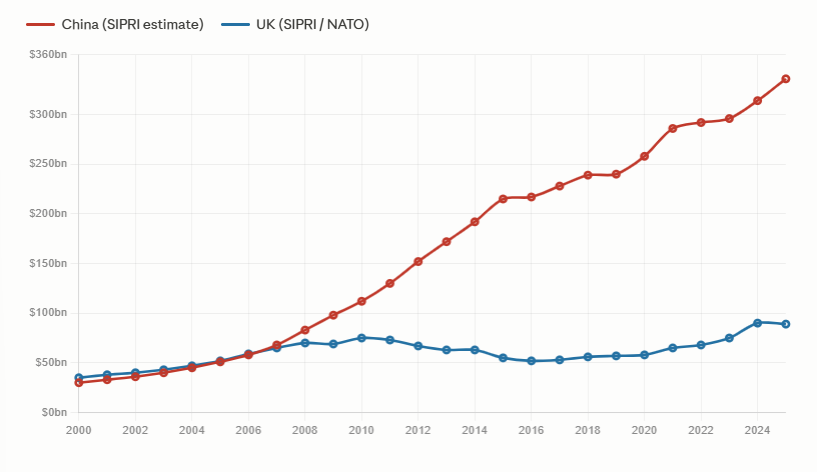
To put this in a UK context, one need only note that the UK outspent China on defence in 2000, spending $35bn to China’s $30bn. The two then reached parity in 2007-8, before UK spending collapsed in 2010. Chinese increases have only gone on to grow by exponentially. China now spendings 3.8 times more than the UK, spending $336bn to the UK’s $89bn. In addition, Beijing has created a global-leading manufacturing sector, which supports a world-class defence industry, providing a capability that far exceeds those of the UK and Japan – those that comparison is not uniform across sectors.
Shipbuilding is by far, China’s greatest strategic asset, the recipient of much of China’s defence spending and accounting for 53 per cent of global shipbuilding capacity. The China state Shipbuilding Corporation alone has built more commercial vessels by tonnage in 2024 than the entire US shipbuilding industry has built since the end of World War II. The UK, by contrast, is undergoing what has been called “a difficult transition”, by the UK Chief of Defence Staff and will only be able to manage 8 Type 26 frigates over the next 15 years. Japan has a more promising shipbuilding capability but has seen much of its market share reduced by Chinese and Korean competition. Despite this, it has four naval shipbuilders and it can build hulls more quickly than the UK.
Air power is said to be the area of British core strength, though here the strength is in engine-building rather than aircraft design and production. Over the past two decades, the UK has chosen to pursue multilateral or consortium aircraft, from the UK-Germany Tornado, to the UK-Germany, Italy, and Spanish Eurofighter Typhoon, and the UK-Japan-Italy Global Combat. According to one recent critique from the National Security Journal, the cost efficiencies of the Typhoon were such that it has become “the most expensive tactical aircraft ever built by the human race”, due to prohibitive flying costs. GCAP, the last consortium, is supposed to be a moment of Japanese innovation and joint co-development, though UK funding and appetite seem to be slow.
And China? Well, the nation that just accused Japan of remilitarization has developed a formidable aviation industrial base, developing 5.5 and 5th generation aircraft like the J-35 and the J-20 stealth fighter. While Chinese engines lag behind the UK’s Rolls Royce lead, the gap has narrowed considerably with the WS-15 engine.
The manufacturing base that China built over the past 30 years has been deliberately developed with dual-use and military end design at the front end. China is very well placed to ramp up artillery and missile munitions, build up armor and small arms stockpiles, as well as modernize its nuclear enterprise. In addition, they dominate the drone manufacturing industry that has revolutionized warfare over the skies of Ukraine. All in all, China has a defence industrial complex that dwarfs those of the next 10 largest nations – after the US. And even then, it dwarfs the US when it comes to replacing lost stock.
So why did Xi Jinping become so animated about Japanese remilitarization in discussions with Donald Trump? The obvious reason is that Japan is a triggering nation for China – the historical examples of Japanese invasion and war on China remain a regional sore spot. However, this is a clear red herring since the numbers show us that Japanese defence spending was only $62bn to China’s $336bn in 2025. No, the real reason for Xi’s anger is Taiwan, China’s obsession with “reuniting” with a “wayword province” and the strong cultural and political linkages between Japan and Taiwan. China’s real ire comes from the perception that Japan would cooperate closely with the United States – providing the forward-deployment capability for air and naval units as well as possibly united in combined arms – to defend Taiwan from a Chinese attack.
All of this after Prime Minister Takaichi said that a Chinese attack of Taiwan would pose “an existential threat” to Japan – drawing a clear legal argument for deploying its military in a self-defence manner consistent with legal requirements. And while Japan is not remilitarizing, it is preparing to defend Taiwan – that is certainly something for Xi to lose sleep over.

