



by Major (Ret) Andrew Fox
Iran has learned a lesson that Hamas demonstrated in Gaza: in the age of social media, the side that influences emotion can fracture coalitions and constrain policy without winning the conventional fight.
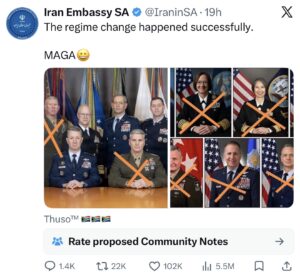
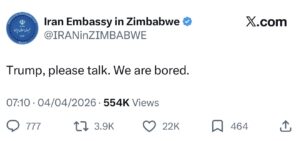
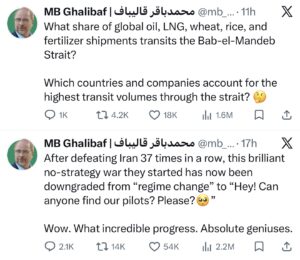
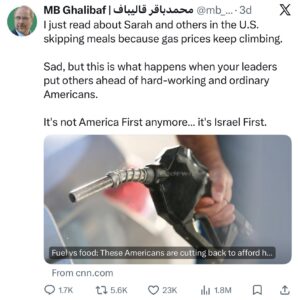
These screenshots are a long way from traditional diplomatic cables. They are written like the internet. “MAGA 😀”. “Trump, please talk. We are bored.” “It’s not America First anymore… it’s Israel First.” The tone is snide, intimate, and frictionless. It is designed for reposting, not deep engagement. The monstrous Iranian regime may be on its heels militarily, but the communication skills on display remain powerful. Iranian diplomatic and political accounts are speaking to Western audiences in the idiom of the platform, and too often they are doing it better than Western politicians speak to their own publics.
The polish of Hamas’s information campaign did not come out of nowhere. In my Henry Jackson Society report, Information Manoeuvre, last year I argued that Hamas fought the Gaza war on two fronts: a physical battlefield and an information war, using media messaging, emotional propaganda, and disinformation to undermine Israel’s legitimacy and weaken the unity of its allies. The report also notes that Iran, alongside Russia and China, amplified Hamas’s narratives through state media and covert influence campaigns. Tehran was one of the amplifiers of the information war around Gaza, and it has clearly been paying attention to what worked.
The lesson was unmistakably clear, as I outline in my latest HJS paper, The Psychology of Disinformation. Emotional manipulation surpasses careful exposition, speed outweighs rebuttal, and corrections almost always arrive too late. As both reports demonstrate, false or distorted narratives can continue to influence public opinion even after they are challenged, and Hamas’s disinformation and emotive media campaign aimed to alienate Israel from the public and international support that underpin its freedom of action. In democratic societies, disinformation-charged protests and media pressure can compel policy changes, as we saw over Gaza. This is what the Iranian regime is trying now.
The Iranian messaging in these examples resembles information manoeuvring in its purest form. The aim is not to persuade everyone that Tehran is benevolent. Instead, it seeks to portray Washington as isolated, hypocritical, costly, and politically toxic. It exacerbates existing divisions: anti-war sentiment, distrust of elites, anger over fuel prices, resentment of foreign entanglements, suspicion of allied burden-sharing, and the belief that ordinary voters are footing the bill for somebody else’s war. Snark is part of the strategy: humour reduces resistance, and memes spread more effectively than ministerial statements.
Drones transformed the physical battlefield by increasing the scale while lowering the cost of precision strikes. Similarly, the internet has revolutionised information operations. You no longer need to control newspapers or TV networks to influence foreign opinion on a large scale. Instead, you require speed, emotional calibration, algorithmic expertise, and content that appears native to the feed. In the social media era, perception has become as crucial a domain of warfare as land, sea, air, or cyber. A weaker actor can seek strategic success by eroding will and international support rather than by outright victory on the battlefield.
In Clausewitzian terms, information manoeuvre targets the people first and policy second. It exploits passion until political options become limited. It does not need to defeat an army directly. Instead, it aims to make war politically risky, morally questionable, or diplomatically unsustainable. That is the manoeuvrist logic I aimed to convey in my HJS report: undermine will and cohesion, fracture allied unity, and disconnect a state from the public and international support that upholds its freedom of action.
In Iran’s case, that attack has been assisted by Trump’s approach to allies. France, Italy, and Spain have all resisted parts of American military actions linked to the conflict with Iran, with Spain closing its airspace to US planes involved in strikes and France asserting that NATO is for Euro-Atlantic defence, not offensive operations in the Strait of Hormuz. European nations initially declined Trump’s request for them to send their naval forces to the area, and the subsequent initiative led by Britain and France to discuss Hormuz security is still in early stages, separate from a US-led war effort, and centred on options after hostilities. Trump has gifted the regime exactly the type of strategic environment Tehran can exploit online, enabling Iran to claim to Western audiences that Washington cannot even keep its own allies united.
The domestic American outlook remains just as favourable to Iran’s strategy. Reuters/Ipsos found Trump’s approval dropping to 36% in late March, his lowest since returning to office, with only 25% approving of his handling of the cost of living and 61% disapproving of the strikes on Iran. A separate Reuters/Ipsos poll showed that 66% of Americans wanted the United States to end its involvement swiftly, even if it did not achieve all its aims, while more than three out of four opposed sending ground troops. Tehran understands the terrain: it is pushing at an open door.
There is a stark irony here. A regime that suppresses its own information space has become very skilled at weaponising ours. Iran has threatened individuals accused of helping hostile states with the death penalty and asset seizures, and stated that even sharing photos or videos that could assist enemy targeting might be considered intelligence cooperation. Meanwhile, outside Iran, we may observe a coordinated effort across social platforms. A Clemson Media Forensics Hub report published in March identified at least 62 IRGC-affiliated accounts pretending to be users in the Americas and the British Isles, systematically amplifying divisive content aligned with Iranian narratives. Iran’s strategy is to flood the zone with volume to generate confusion and influence perceptions.
The uncomfortable conclusion is that the Iranian regime often communicates with our people more fluently than our politicians do. It understands the grammar of the feed: compression, identity, grievance, repetition, humour, and resentment. Western governments still too often communicate as if they are drafting committee minutes. By the time the careful statement arrives, the emotional truth of the event, real or fabricated, has already been fixed in millions of minds.
The solution is not to imitate authoritarian lies. It is to relearn democratic strategic communication. That is why I argue for integrating information operations into doctrine, developing rapid-response communications capacity, and empowering diplomats and digital teams to engage online in real time. Democracies still hold the long-term edge of credibility, pluralism, and openness, but those advantages only matter if they are used at the pace of the modern battlespace.
Modern warfare no longer fits neatly on a map. The home front, alliance networks, and news feeds have merged into a single contest over influence. A meme from an embassy account in Pretoria or Harare can now operate in the same battlespace as a missile launch in the Gulf. Drones have made cheap, precise violence possible on a large scale. The internet has enabled affordable, targeted influence at scale. Hamas demonstrated this in Gaza. Iran has watched, learned, and adapted. We are still catching up.

