




In January 2026, online military commentary site War on the Rocks published a piece by retired Col. Andy Milburn that sharply criticises the Israel Defence Forces (IDF) over civilian harm in the 2023–25 Gaza war. Milburn argues that the devastating Palestinian death toll cannot be solely explained by the inherent risks of urban combat. Instead, he claims Israeli operational choices of permissive targeting, broad definitions of threats, and an emphasis on force protection led to unnecessary civilian suffering. Given War on the Rocks’ prior reputation for serious military analysis, Milburn’s article merits a careful, evidence-based rebuttal. This response will systematically scrutinise his claims, considering overlooked facts on the ground, from Hamas’s battlefield tactics to the realities of international humanitarian law. The aim is to offer a more balanced, credible assessment of Gaza’s tragic outcomes and where responsibility genuinely lies.
Milburn’s core thesis is that Gaza’s massive civilian death toll resulted from Israeli policy choices rather than being an unavoidable consequence of fighting Hamas in a dense urban environment. In his article, he notes that approximately 71,000 Palestinians were killed over two years of war and describes this as “civilian death on a scale that cannot be explained by inevitability alone”. In other words, Milburn believes the civilian carnage was excessive, preventable, and a product of Israel’s rules of engagement and targeting decisions that prioritised Israeli soldiers’ safety over Gaza’s civilians. He depicts the IDF as having defined military targets too broadly and used force too readily despite intelligence gaps, thereby shifting risk onto the civilian population. According to Milburn, Gaza’s devastation was not a tragic byproduct of Hamas’s brutal tactics or the complexities of urban warfare, but rather a direct consequence of Israel’s deliberate conduct.
The overall scale of loss is not disputed here. What is fiercely contested is who those casualties were. The Hamas-run health authorities do not distinguish between combatants and non-combatants in their public tallies, and they have every incentive to report as many deaths as possible as innocent civilians. Israeli intelligence assessments by late 2025 suggested that approximately 20,000–25,000 of the dead were Hamas fighters.[1] If true, this would imply a civilian-to-militant ratio of about 3:1, meaning roughly one-quarter of those killed were combatants. Milburn, by contrast, highlights reports that “80%” were civilians (which Milburn misattributes to Israeli intelligence) and implies that virtually all 71,000 were innocents. This assumption overlooks considerable uncertainty, including the Hamas-run Ministry of Health’s own data showing that the most significant proportion of deaths were fighting-age males.[2] In reality, thousands of Hamas militants very likely died in the fighting (Hamas officials themselves in early 2024 acknowledged 6,000 fighters killed), so treating every unclassified death as a civilian is misleading.[3]
The Gaza Health Ministry’s figures are compiled under clearly partisan conditions. Hamas controls the reporting. Hamas has an interest in minimising its fighter losses; for example, there have been documented cases of Hamas misattributing certain deaths to Israeli strikes that were actually caused by Hamas’s own actions (such as militant rocket misfires or executions of alleged “collaborators”).[4] This means the raw casualty statistics Milburn cites assign 100% of the bloodshed to Israel, whereas in reality, some civilians were killed by Hamas’s practices. All of this is not to deny the scale of Palestinian civilian suffering; it is to emphasise that the often-cited civilian percentage is imprecise and likely inflated by methodological bias. Any good-faith assessment must grapple with this and not simply assume that every death not explicitly identified as a militant is automatically a civilian.
A high civilian-to-combatant ratio by itself does not establish illegality. War is not a straightforward numbers game. Modern urban warfare against an embedded adversary often results in far more civilian casualties than enemy fighter losses. For example, in the 2016–17 Battle of Mosul (Iraq), an estimated 9,000–11,000 civilians were killed over nine months of fighting, while perhaps around 2,000 Islamic State fighters were killed – roughly a 3:1 ratio favouring civilian casualties, despite US and Iraqi forces’ efforts to minimise harm.
Other urban campaigns, such as Fallujah (2004) and Raqqa (2017), experienced similarly tragic outcomes. Compared to this, if roughly 20–25k of Gaza’s ~70k dead were enemy combatants, Gaza’s civilian harm ratio (~3:1) would fall within the grim norm for intense urban combat; perhaps even lower than Mosul’s, not higher. This does not justify any actual violations, but it highlights that a high raw toll alone does not determine legality or morality. What matters under international humanitarian law is whether each attack was proportionate and precautions were taken, not the total body count afterwards. Milburn’s focus on raw numbers without considering context risks leading to a flawed conclusion.
Gaza’s situation also had a deadly aggravating factor that Milburn downplays when compared to Mosul: civilians had nowhere to go. In most conflicts, many civilians can flee the combat zone entirely. In Gaza, some 2 million people were trapped in a sealed enclave. Even when Israel urged evacuation from Gaza City to the south, civilians remained inside Gaza, often crammed into an ever-shrinking area under fire. By contrast, in Mosul the majority of the population (hundreds of thousands) escaped the city before the final assault. This fundamental difference meant that the total number of civilians exposed in Gaza was vastly higher. One cannot compare raw casualty figures between Gaza and battles like Mosul or Fallujah without recognising that nearly the entire population was stuck on the battlefield in Gaza.
Then-US Defence Secretary Lloyd Austin observed that Gaza’s density made it “very, very difficult” to carry out operations, and “Hamas routinely uses civilians as shields, placing their sites near hospitals, mosques…that adds to the complexity”.[5] All of this highlights that the high civilian toll, while tragic, was sadly predictable given Hamas’s tactics and the population’s entrapment – it does not alone prove that Israel acted unlawfully or could have prevented most of those deaths.
Milburn states that, “evacuation orders compressed civilians into areas that were subjected to repeated strikes”. This flies in the face of evidence that Israel did its utmost to respect areas such as al-Mawasi, which was designated a “humanitarian zone” (not, it must be noted, a “safe zone” under international law). As Orbach et al (2025) note:
“Despite housing over half of Gaza’s population during the later stages of the conflict—and despite Hamas’s cynical use of the area for military purposes—the reported death toll within the designated humanitarian zone remained comparatively low. According to BBC Verify, around 550 deaths were recorded in the zone from May 2024 to January 2025, including 90 in the strike targeting Mohammed Deif, Hamas’s military commander. This figure accounts for just 2.1% of all identified deaths between May 2024 and March 2025. Using the GMO “reliable media report”
supplemented data for April 30, 2024, this figure is 3.5% of all fatalities between May 2024 and March 2025.”
This demonstrates a clear intention to avoid striking humanitarian zones, where possible. That such strikes took place are a result of Hamas using the civilian population in al-Mawasi for cover, including senior commanders (such as Deif), hostages, arms stores, and firing rockets.[6]
A significant oversight in Milburn’s analysis is the lack of any substantial discussion about Hamas’s military position in Gaza; most notably, the complex underground and booby-trapped battlefield that Israeli forces had to face. Milburn does not even mention the word “tunnel” in his approximately 3,000-word piece, yet Hamas’s tunnel network was pivotal to the conflict. By early 2024, Israeli intelligence estimated that Hamas had excavated between 350 and 450 miles of tunnels beneath Gaza—roughly 560–720 kilometres of underground passages spanning beneath city streets, connecting bunkers, weapon depots, command posts, and firing positions. (For context, the entire Gaza Strip measures only 25 miles in length; Hamas essentially constructed a multi-layered underground city beneath the surface.)
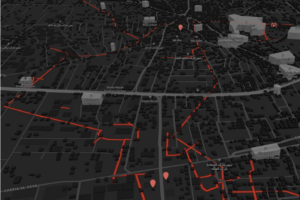
Fig 1: A small sample of tunnels geolocated by Honest Reporting, showing Hamas tunnels running under schools, mosques, a graveyard and medical centre.
(source: tunnels.honestreporting.com)
Later Israeli estimates rose even higher, and Hamas itself boasted that its tunnel “metro” stretched over “hundreds of kilometres”, comparable to the scale of the New York City subway system.[7] While the exact length is difficult to verify independently, there is no doubt that this was one of the most extensive underground military complexes ever built beneath a populated area. Even ISIS’s renowned tunnels in Mosul were “much less extensive” than those Hamas constructed in Gaza.[8] No modern military force has faced an underground fortress of this size embedded directly beneath civilian neighbourhoods. Ignoring this factor, as Milburn does, seriously distorts any assessment of proportionality or risk – the tunnels enabled Hamas fighters to emerge anywhere, concealed by civilian cover, significantly complicating Israel’s options.
Hamas fighters could shelter and manoeuvre underground, then emerge from tunnel shafts in the middle of residential blocks, strike Israeli troops or launch rockets, and vanish again. They built many tunnel entrances within civilian structures, including private homes, schools, and even kindergartens, specifically to exploit the protection those civilian sites offered.[9] Israeli forces uncovered thousands of tunnel access points hidden in houses, mosques, and other non-military buildings. One Israeli commander explained that they learned to expect a tunnel opening “below an area with a school, hospital or mosque” – a Hamas defensive “triangle” linking military tunnels to civilian sites.[10]
This reality directly affected targeting decisions: striking a seemingly innocuous building often risked collapsing a tunnel or hitting a Hamas bunker underneath, yet not striking it meant leaving enemy strongholds intact. Milburn’s critique ignores the tunnels, but for Israeli planners, the tunnel network was a strategic centre of gravity for Hamas. Any serious analysis of the Gaza campaign must acknowledge that Israel was fighting an enemy that had burrowed beneath every neighbourhood, using the city’s own infrastructure as a shield.
Hamas’s above-ground tactics increased the danger. Over 17 years of Hamas control, Gaza’s urban areas were intentionally turned into weapons. Homes and city blocks were fitted with an unprecedented density of improvised explosive devices (IEDs) and booby traps. Frontline Israeli units reported encountering deadly traps “every few dozen meters” as they moved through built-up areas – a level of IED concentration with few, if any, precedents in urban warfare.[11] A senior IDF engineer described the threat as “very, very extensive use of IEDs” and an environment where “they simply booby-trap anything they can”, including civilian sites like schools and even “booby-trapped kindergartens” with tunnel shafts inside.[12]
Hamas saturated the battleground with explosives. Tens of thousands of IEDs were planted across Gaza (Israeli sappers privately suggested figures up to 100,000 bombs), turning entire civilian apartment blocks into deathtraps. We need not accept any single estimate as exact to understand the point: the scale of Hamas’s fortification was extraordinary. Every structure was potentially a bomb; every approach route could be a kill zone. This imposed extreme caution on the IDF and inevitably caused widespread destruction of buildings suspected of being wired to explode.
Milburn’s essay hardly mentions these tactical realities. Yet, without understanding the battlefield, one cannot fairly assess why the IDF carried out operations as it did. Any claim of “excessive” force must be considered alongside the fact that Hamas created a battlefield unlike any seen in modern times, where civilian infrastructure was heavily booby-trapped and militarised. While this context does not automatically justify every Israeli action, it is crucial for any fair judgement of proportionality.
Milburn’s commentary downplays how Hamas’s own tactics contributed to Gaza’s civilian peril. For Hamas, hiding behind and among civilians was a central strategy. The following documented examples illustrate how Hamas’s embedding of military assets in civilian sites, and even coercion of the population, forced agonising choices on Israel’s commanders:
- Tunnel shafts beneath schools. In November 2023, during the war’s initial phase, Israeli forces destroyed a Hamas tunnel running adjacent to a United Nations school in Maghazi, Gaza.[13] Investigations revealed that Hamas had been constructing tunnels directly underneath UNRWA school compounds for years, effectively using these schools as cover for underground military infrastructure. The UN agency itself condemned this violation of neutrality in the strongest terms. Such tunnels transformed civilian schools into potential military targets and hazards, unbeknownst to the hundreds of families sheltering there. This demonstrates Hamas’s deliberate embedding of its war-fighting network beneath civilian shelter.
- Weapons and fighters in hospitals. It is well documented that Hamas placed command centres and armouries in or around medical facilities. A prominent example was Gaza’s main hospital, Al-Shifa. In mid-November 2023, amid intense fighting, Israeli troops conducting a limited raid found a Hamas tunnel shaft and a cache of weapons inside the Shifa hospital compound. The IDF released photos of the discovered tunnel entrance concealed within the hospital and of improvised weapons stored on the premises.[14] This evidence confirmed that Hamas was using even hospitals for military purposes. Hamas gunmen engaged Israeli forces in firefights within hospital courtyards on multiple occasions during the war.
Every military force around the world agrees that hospitals lose their protection if used by combatants, yet attacking an enemy position in a hospital is clearly risky for the sick and innocent people. Hamas’s misuse of Al-Shifa put Israel in a severe dilemma: ignore hostile activity at a hospital and lose a military advantage, or act and face international condemnation. (Israel chose to carry out tightly controlled operations in these sites, but still received strong criticism.) The Shifa case exemplifies Hamas’s human shield tactic of placing fighters and important infrastructure in locations they expect Israel will hesitate to strike.
- Coercive use of human shields. Hamas has forcibly prevented Palestinian civilians from evacuating battle zones when Israel warned them. There is evidence to support these claims. In late October 2023, Israeli intercepts captured a phone call from a Gazan man desperately explaining that Hamas “is blocking people from fleeing” the northern Gaza City area – “placing roadblocks with cars” and “shooting at people trying to leave”.[15]
This was corroborated by multiple reports during the conflict. For instance, in September 2025, as Israel’s ground invasion loomed, roughly only 60–80k out of 1 million Gaza City residents had managed to evacuate south; Hamas fighters were physically attacking those who attempted to go, even shooting some families in their cars to terrify others into staying put. Hamas officials also publicly urged civilians to ignore Israeli evacuation warnings, calling it their “patriotic duty” to remain in place.[16]
The purpose behind these actions was evident: Hamas aimed to keep civilians mixed with its fighters, making IDF operations more difficult and applying political pressure against Israel. Hamas used the civilian population as a strategic shield. This coercion is well documented and directly contradicts Milburn’s claim that there was little evidence of Hamas employing human shields. On the contrary, Hamas both promoted and enforced the presence of civilians in the line of fire – a war crime that significantly increased Gaza’s civilian death toll.
These case studies underscore a fundamental point: Hamas’s unlawful blending of combatants among civilians had a direct effect on civilian risk and on Israeli targeting decisions. Any balanced assessment of the Gaza war must acknowledge that Israeli forces faced an enemy that wanted civilians to be in the crossfire. Milburn’s portrayal, which largely writes Hamas out of the equation, presents an incomplete and skewed picture of how and why so many civilians died.
Another significant flaw in Milburn’s critique is the failure to recognise Gaza’s context within a broader wartime situation. Israel’s campaign in Gaza from 7 October 2023 onwards cannot be seen as a narrow counterinsurgency in isolation; it was part of a war for national survival fought on multiple fronts. Following Hamas’s 7 October massacre (in which Hamas terrorists killed approximately 1,200 Israelis and kidnapped over 240 civilians), Israel found itself under attack from seven fronts: Gaza, Lebanon, the West Bank, Yemen, Syria, Iraq and Iran. Iran and its proxy militias actively opened new fronts or threatened Israel in the north and elsewhere, creating a regional siege scenario. Therefore, Israel’s Gaza operation was just one theatre in a wider defensive war against various hostile forces.
Most crucially, the existential threat posed by Hamas was unmistakable. The 7 October atrocity was the deadliest massacre of Jews since the Holocaust, and Hamas openly pledged to repeat such genocidal attacks “again and again”.[17] Milburn largely ignores 7 October and Hamas’s explicit promises to continue exterminating Israeli civilians. He writes as if Israel decided to unleash force in Gaza in a strategic vacuum. In reality, Israel was responding to a terror group that had already carried out mass slaughter and was entrenched on Israel’s border, threatening millions of Israelis with ongoing rocket barrages and further incursions (including nearly 14,000 rockets fired at Israel from Gaza during the war itself).[18]
Milburn’s comparison to US battles in Iraq completely breaks down here: American forces in Mosul or Fallujah were not defending American cities from daily rocket fire, nor were they rushing to rescue hostages held in tunnels beneath a neighbouring city. Israel was. When an enemy is at your doorstep, orchestrating ongoing attacks, the urgency and scale of the response will inevitably differ from those of a discretionary expeditionary campaign overseas. The Israeli leadership and IDF commanders genuinely perceived the Gaza war as a fight for the survival of their population against an enemy seeking its annihilation. This context of national survival profoundly shaped Israel’s approach to targeting and risk. Milburn entirely dismisses this context.
Finally, it is vital to address the international humanitarian law (IHL) dimensions that Milburn references. Here we must be clear: Hamas’s flagrant breaches of IHL do not absolve Israel of its own legal and moral responsibilities. Under the laws of war, each party must continue to distinguish and proportionally minimise civilian harm as much as possible, regardless of the enemy’s misconduct. This rebuttal is not an attempt to say “Hamas was worse, so Israel gets a free pass”. Israel’s actions, too, must be examined against IHL standards, and if there were instances where Israeli forces violated those standards, they should be condemned. Nonetheless, Milburn’s analysis offers an overly simplistic view of proportionality and overlooks the realities of battlefield constraints.
Proportionality is not about a body count ratio. IHL’s proportionality principle forbids an attack if the expected incidental civilian harm would be excessive compared to the concrete and direct military advantage anticipated.[19] This is an inherently context-specific, ex ante judgment. Commanders must evaluate, before an attack, whether striking a legitimate target (for example, a Hamas rocket team or a weapons cache) is likely to cause collateral damage that outweighs the military benefit of neutralising that target. Factors include the value of the target, the urgency of neutralising it, the reliability of intelligence, and the risk to civilians if the target is or isn’t struck. Importantly, proportionality does not mean zero civilian casualties, nor does it impose a quantitative formula like “no more than X civilians per militant”. It also does not assess legality by the final tally after the event (on which Milburn fixates).
The law recognises that in war, incidental civilian harm can occur, even when attackers try their best to avoid it, as long as that harm is not anticipated to be clearly excessive in relation to the military advantage. Milburn’s approach of using Gaza’s high civilian death toll as proof of Israeli guilt downplays this vital nuance. The key legal question is whether Israeli forces took reasonable precautions and made proportionality judgments in good faith based on what they knew at the time. Numbers alone “cannot settle questions of responsibility,” as Milburn himself notes, but then he proceeds to imply the opposite through his tone and conclusions.
In Gaza, Israel’s possible options were often limited by Hamas’s actions. International law does not require a military to simply endure enemy attacks indefinitely or send its soldiers on reckless missions to meet an abstract proportionality standard. For instance, if Hamas set up a command post beneath a hospital, Israel is not obliged to allow that post to operate without consequences. International Humanitarian Law bans using civilians as shields because it compromises their protection. While Israel must still aim to reduce harm, the law recognises that the presence of human shields cannot make a legitimate military target entirely immune.
Hamas’s illegal tactics do not alter Israel’s legal obligations, but they also do not remove them; the obligations stay the same. Milburn’s critique sometimes suggests he believes any civilian death is too many unless Israel can prove beyond all doubt that a target was valid and no alternative existed. That is an unrealistic standard not required by IHL. In Gaza’s fog of war, Israeli commanders often must make rapid decisions with imperfect intelligence – for example, striking a building where a high-value militant was thought to be, even though civilians might be inside. If they reasonably believed the target’s military importance was high and took steps to reduce civilian risk (such as issuing multiple warnings to evacuate), such a strike can be lawful even if civilians are later killed. Milburn’s armchair generalship, ignoring Israel’s operational dilemmas, fails to acknowledge these difficult choices.
Throughout his piece, Milburn compares Israeli conduct unfavourably to US operations in places like Mosul, suggesting Israel should have done more to protect civilians. However, as discussed, Gaza posed unique challenges: a fully trapped population, an enemy deeply embedded within civilian infrastructure, and an ongoing threat to Israel’s own civilians (Hamas rockets and the context of a wider regional war). Other Western militaries engaged in similar conflicts (the US in Iraq, NATO in Afghanistan, etc.) often took measures such as establishing safe corridors or pausing operations to facilitate evacuations. Israel did make some attempts at pauses and corridors, but Hamas frequently undermined them (by blocking evacuations or attacking convoys).
Milburn largely overlooks how Hamas drastically increased the difficulty of conducting a “surgical” military campaign. To illustrate: Hamas fighters would fire from within crowds of displaced civilians or move into UN shelters after attacking, effectively daring Israel to respond. This blurred the lines between civilians and combatants in real time. Israeli soldiers on the ground faced an enemy that did not wear uniforms and exploited urban chaos as cover. These are not excuses for any reckless strikes, but they provide essential context. A fair analysis would acknowledge that even the best-trained army would struggle to avoid civilian harm under such conditions. Milburn’s focus, nearly solely on Israeli “choices”, suggests Israel could have attained the same military goals with much less damage if it had chosen differently. He offers little insight beyond generic appeals to restraint. This approach risks echoing armchair generalship that fails to engage with the tactical reality of Gaza.
One must also consider the dangerous precedent that Milburn’s one-sided assignment of blame could set. According to his account, Israel’s overwhelming firepower in Gaza is nearly entirely responsible for civilian deaths, while Hamas’s strategy of using human shields is treated as a minor detail. This framing effectively rewards the use of human shields. If an army knows its enemy will be condemned for any civilian casualties, while it (the defender) faces little blame for hiding behind civilians, the perverse incentive is to continue using this unlawful tactic.
International law explicitly prohibits using civilians to make targets immune (Additional Protocol I, art. 51(7)) for this very reason – it weakens the law’s protections when followed. Milburn’s analysis minimises Hamas’s role to the extent that it may encourage the Hamas strategy: bunker under hospitals, coexist with families, and then hope global outrage restrains Israel. That is a dangerous message to send. To be clear, Israel is not exempt from blame if it caused disproportionate harm, but we cannot ignore that Hamas’s unlawful tactics are relevant to the outcome. Both legally and morally, Hamas bears significant responsibility for endangering Gazan civilians. Ignoring this, as Milburn does, distorts the moral balance and creates a one-dimensional view of the war.
Hamas’s illegality does not absolve Israel. The IDF still faces tough questions. Did every airstrike truly follow the principle of proportionality? Were target validations and intelligence sufficiently rigorous amid the chaos? Did Israel do everything possible to minimise harm (without abandoning its mission)? These are valid questions, and there are grounds for criticising Israel. Indeed, Israeli authorities have at times acknowledged failings or launched investigations into incidents with high casualties.
This rebuttal is not an unfounded defence of all Israeli actions. Instead, it is a plea for analytical balance. Milburn’s broad accusation, essentially claiming that Israel deliberately chose a policy of killing civilians rather than risking harm, is not substantiated by the full record. Proportionality in war is a complex challenge, and reasonable observers can debate specific instances. However, such debate must consider the realities of Hamas’s tactics of human shielding, the unprecedented battlefield conditions, and the inherent uncertainty of war. Once these factors are taken into account, the narrative shifts from a simplistic “Israel behaved recklessly and Gaza’s civilians paid the price” to a more nuanced (and uncomfortable) truth: Hamas created a battlefield where high civilian casualties were almost inevitable, and Israel’s military, while endeavouring to achieve its mission to halt ongoing attacks, made mistakes and caused tragic, unintended consequences, but did not fundamentally deviate from how other professional armies have operated under similar or worse constraints.
Holding Israel to strict IHL standards is justified; expecting zero civilian harm in a scenario deliberately designed by Hamas to maximise civilian casualties is not. A calm analysis understands Hamas’s illegal actions as a significant factor without excusing Israeli mistakes. It also reinterprets proportionality not as a simple casualty measure after conflict, but as a continual obligation of responsible military decision-making amid uncertainty. Milburn’s critique, by largely ignoring the real battlefield limitations, does a disservice to his stated goal of learning how to better protect civilians. A more balanced discussion would recognise that both Hamas’s tactics and Israeli decisions influenced the outcome, and that the real challenge is how democratic armed forces can maintain humanitarian standards when fighting an opponent who intentionally seeks to undermine them. That is the conversation we need, and it begins by correcting the record that Milburn’s biased argument left so vulnerable to critique.
[1] https://honestreporting.com/no-the-idf-did-not-accept-hamas-gaza-casualty-figures/
[2] https://henryjacksonsociety.org/wp-content/uploads/2024/12/HJS-Questionable-Counting-–-Hamas-Report-web.pdf, p.20
[3] https://www.reuters.com/world/middle-east/israels-six-week-drive-hit-hamas-rafah-scale-back-war-2024-02-19/
[4] https://lieber.westpoint.edu/facts-matter-assessing-al-ahli-hospital-incident/; https://www.bbc.co.uk/news/articles/c99g3p52k15o
[5] https://www.washingtonpost.com/world/2023/12/22/hamas-booby-traps-gaza/
[6] https://www.fdd.org/analysis/2024/07/22/idf-terrorists-used-humanitarian-zone-to-launch-rockets-at-israel/
[7] https://www.reuters.com/world/middle-east/israel-says-it-uncovered-800-shafts-hamas-tunnels-below-gaza-2023-12-03/
[8] https://jstribune.com/frantzman-comparing-gaza-with-mosul/
[9] https://henryjacksonsociety.org/wp-content/uploads/2025/05/HJS-Hamass-Human-Shield-Strategy-in-Gaza-Report-WEB.pdf
[10] https://www.timesofisrael.com/gaza-tunnels-stretch-at-least-350-miles-far-longer-than-past-estimate-report/
[11] Interview with Yahalom officer, Jan 2026.
[12] https://www.jns.org/weve-seen-booby-trapped-kindergartens/
[13] https://www.fdd.org/analysis/2023/11/10/hamas-terror-tunnel-next-to-unrwa-school-in-gaza-destroyed/
[14] https://www.reuters.com/world/middle-east/israeli-army-says-it-finds-tunnel-weapons-gazas-al-shifa-hospital-2023-11-16/
[15] https://www.timesofisrael.com/idf-gaza-resident-says-hamas-preventing-evacuations-thousands-return-north/
[16] https://www.jpost.com/israel-news/defense-news/article-866195
[17] https://www.ms.now/morning-joe/watch/hamas-official-vows-to-repeat-attacks-on-israel-again-and-again-until-it-s-destroyed-196930629782
[18] https://www.davidinstitute.org/data-center
[19] https://casebook.icrc.org/a_to_z/glossary/proportionality

