




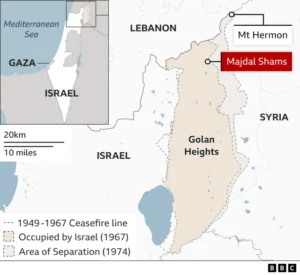
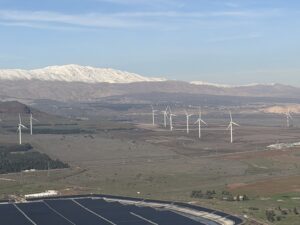
Snow is not common in Israel, but around the Golan Heights, the white-peaked cap of Mount Hermon looms in the distance above the town of Majdal Shams. This predominantly Druze town has a population of just 11,000. Little known before the war, the town sprang to international prominence in July 2024. A Hezbollah rocket fired into Israel landed next to a football pitch, killing twelve Druze children. The rocket was fired from close to the Lebanon-Israel border. There was a shelter near the pitch, but from the time of launch, the children would have had three seconds to reach it. There was no time to give an alarm or take cover.
This is the most tragic example of the security situation faced in Northern Israel after 7th October. As Hamas’ Nukhba forces streamed across the Gaza border to rape, murder and pillage kibbutzim in the Gaza periphery, a rapid repositioning of IDF troops prevented a similar attack from the North. Hezbollah’s Radwan special forces planned the same tactics as Hamas, but on a greater scale. The Radwan force was better armed, trained and more numerous than their Gazan equivalents. Israel had long feared an attack of this nature, and Hezbollah spent years preparing for it. The move of IDF brigades to the North on 7th October successfully deterred any Hezbollah attempt to replicate Hamas’ attack.
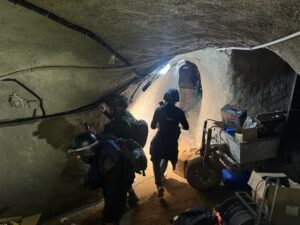
In December 2024, I visited a captured Hezbollah tunnel in Maroun-al-Ras. This tunnel was estimated to be two kilometres long and as deep as 150m, dug through solid chalk. The tunnel contained full lighting fittings, tiled floors in the accommodation areas, air-conditioning and fire-suppression systems. On my return, I researched the electrical fittings: they were Iranian in origin.
The Maroun-al-Ras tunnel entrance was 500 metres from an Irish UNIFIL base. Hezbollah had hidden the excavation by using the spoil to lay a road over the top of the hill under which the tunnel lay. Using historical satellite imagery, one can see the road being laid over time. It goes nowhere; it was simply a way of hiding the digging.
As a former soldier, one feature of the tunnel stood out: with the exception of a few bends and junctions, it was entirely straight. This was not a tunnel to be fought in. There were no 90-degree angles to prevent enfilading fire and no obstacles to prevent the ingress of assaulting troops. This tunnel was a staging post. It was designed for Hezbollah fighters to arrive in civilian profile, change into uniform, collect the numerous arms stored there, and assault into Israel. On leaving the tunnel, this was even clearer. The exit was oriented downhill, along a re-entrant between two high features, and a few hundred metres away, the lights of the Israeli town of Avivim shone. It would be a short run downhill for hundreds of Hezbollah fighters, launching from the tunnel to cross the border and attack.
This is the security situation in which Majdal Shams lives. I met the local mayor, Dolan Abu Saleh. A charismatic man in his forties, in his fourth term as mayor. He was proud of his town and his Druze heritage. He spoke glowingly of the town’s educational record, where 93% of children earn their high school diploma – a higher-than-average rate for Israel.
Lebanon is not the only threat to their security. During the 2011 Syrian Civil War, people in Majdal Shams could see and hear combat on the Syrian side of the border, just a stone’s throw away. The Druze are a small religious minority spread across the Middle East. 600,000 live in Syria, 250,000 in Lebanon, and 120,000 in Israel, with a tiny diaspora spread across the Americas, Jordan, and a few other states.
It seems that the missile strike on Majdal Shams was a tragic and reckless misfire, rather than deliberate targeting. The same cannot be said for the plight of the Druze in Syria. As a religious minority, the Druze have faced oppression wherever they go. In Israel, Syria and Lebanon, Druze communities can often be found on high ground. Traditionally, higher ground is easier to defend.
As threatened minorities, Druze are loyal to the regimes in the countries where they live, as a matter of survival. This included loyalty to the Assad regime in Syria. When Assad fell, the Druze in Syria were negotiating their incorporation into the new regime led by Ahmed Al-Sharaa and Hay’at Tahrir Al-Sham (HTS). These talks progressed slowly due to Druze reservations about HTS’s jihadist origins. In April 2025, there was a dispute between Druze communities and HTS’s General Security Service. What followed was a slaughter. More than 800 were killed, and 900 were injured. These massacres prompted a protective response from the IDF.
IDF policy in Southern Lebanon and Syria can best be described as ‘forward defence’. The IDF has established buffer zones in both countries and will maintain positions in each until the threats are removed. The Syria-Israel border sits on the famous Valley of Tears from the Yom Kippur War in 1973, where vastly overmatched Israeli forces held off Arab attacks for four days. Beneath the Golan Heights to the east sits a long, flat plateau. The Israeli security concern is instantly obvious: the plateau represents a highway along which every jihadi in the Middle East could easily assault and breach into Israel. IDF presence on the dominating Golan Heights and the neighbouring Mount Hermon creates a buffer zone to secure Israel’s borders whilst Syria remains in post-civil war turmoil.
In the middle of this turmoil sit the Druze. An IDF strike on the Syrian Defence Ministry in Damascus appears to have sent the correct message, and the 2025 attacks on Druze communities ceased at scale. However, the Druze in Syria remain isolated, with towns interspersed amongst a hostile Muslim population. They can seldom leave their communities for fear of attack. They cannot access hospital treatment, as that requires travel, so the IDF have facilitated the establishment of a field hospital in their buffer zone area to provide medical care to these communities. The security situation makes ground operations challenging, so the IDF relies on precision airstrikes to de-escalate threats.
Mayor Abu Saleh fears for his fellow Druze. The international community rages about the humanitarian situation in Gaza. Last week, I visited the Civil-Military Cooperation Centre overseeing the ceasefire. The scale of aid going into Gaza is staggering. Meanwhile, Druze women and children in Syria are isolated, targeted and suffering. Abu Saleh described humanitarian efforts as “too little, too late”. In Syria, Al-Sharaa’s government is stuck between religious ideology and economic potential: attempting to rebuild the country whilst the jihadis in his forces have other priorities. The Druze are stuck in the middle.
I asked him what was needed. He emphasised the humanitarian aspect. This year, the British government will provide £254.5 million in aid to Syria. More of it must reach the under-siege Druze, and the Syrian government must “eliminate the threat at source”.
Author’s Own

