



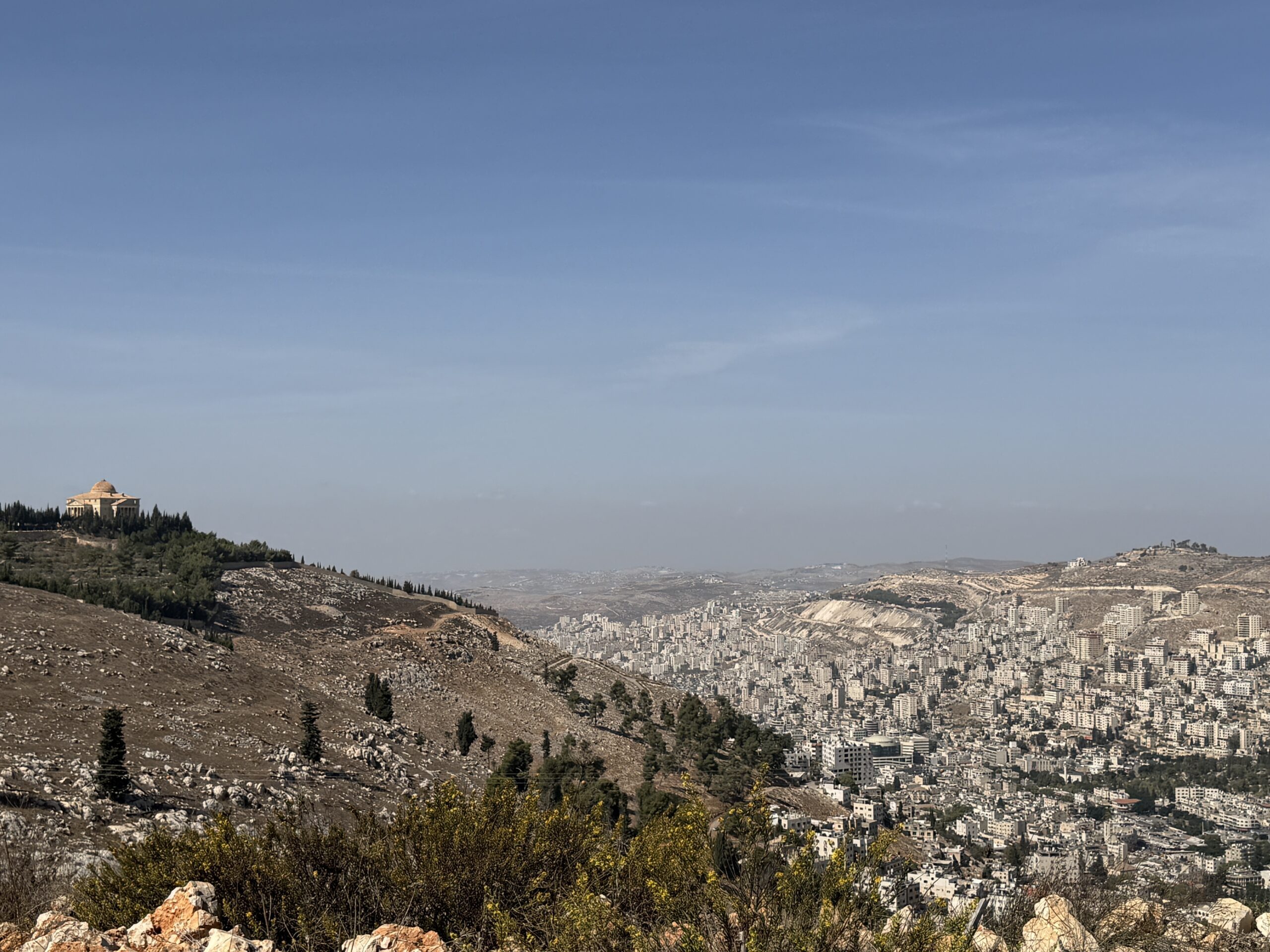
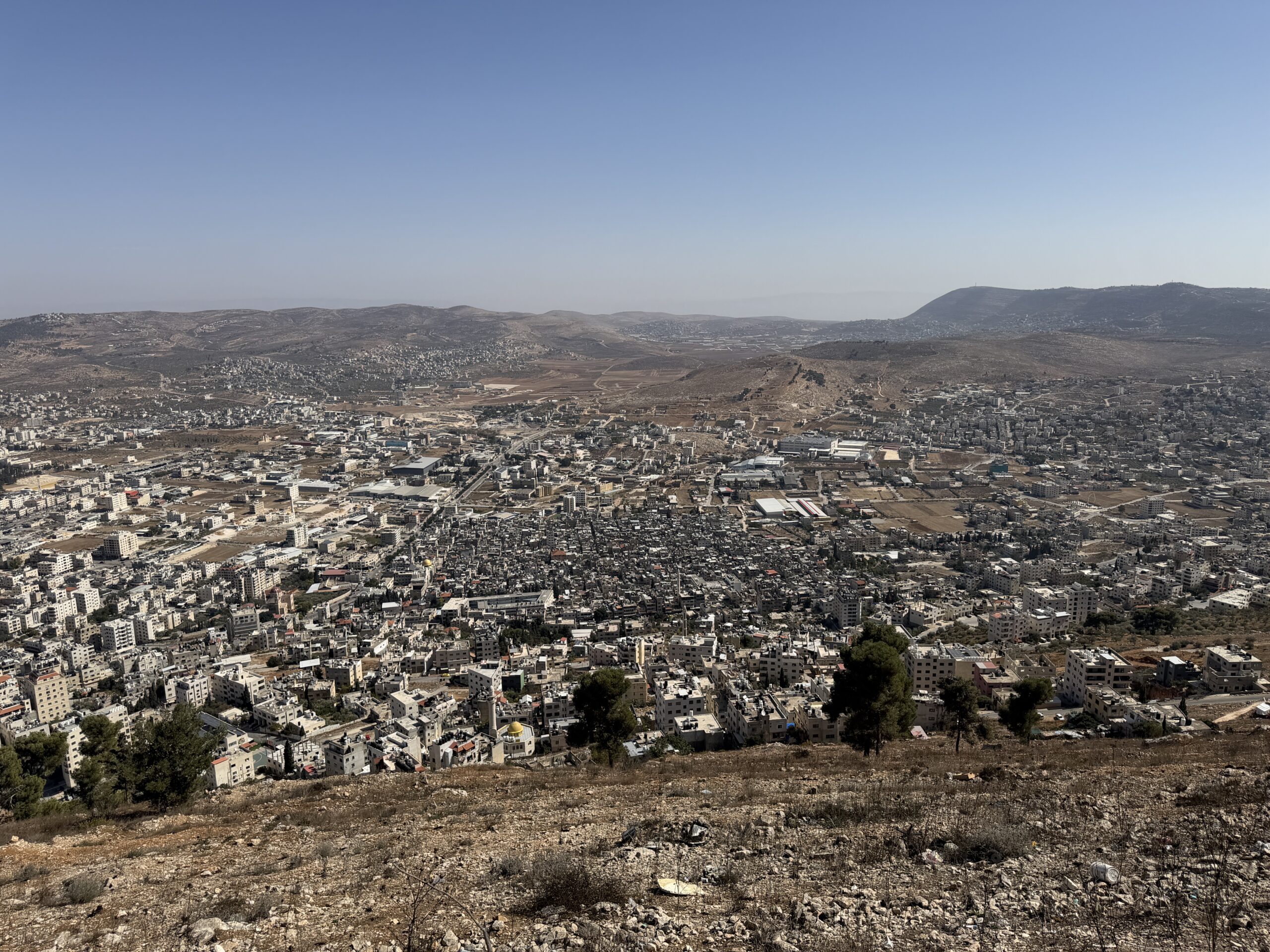
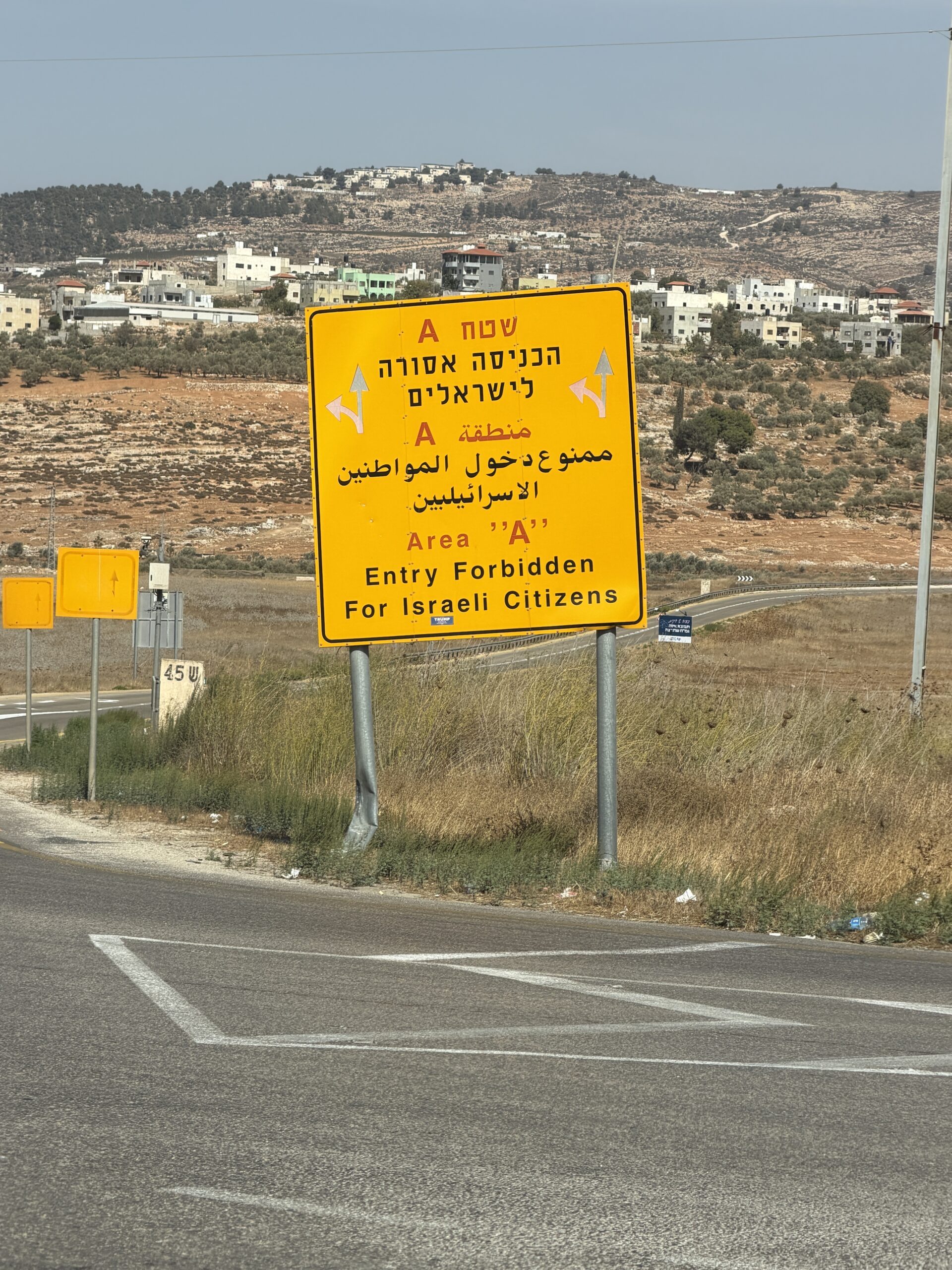
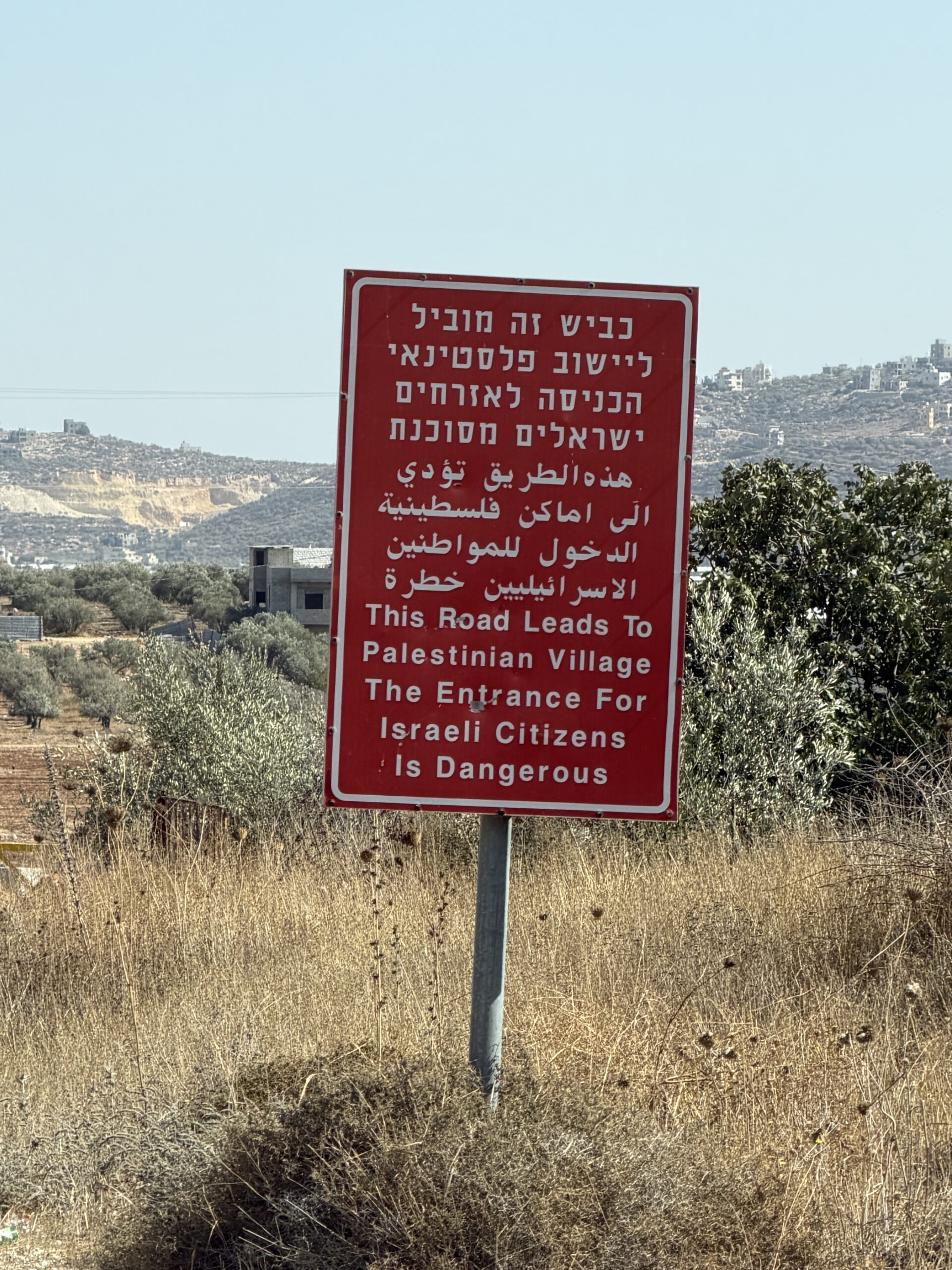
From a lookout above Nablus, the city opens like a relief map: minarets, markets, alleys stacked into the hills. The red‑and‑white signs are impossible to miss: warnings that Israeli citizens must not enter Area A. People often reach for the word apartheid here; what struck me instead was the blunt logic of security. These boundaries of fences, checkpoints, and zones trace not a theory but the hard calculus of violence and fear that has shaped daily life for decades. Under the Oslo framework, certain areas were set aside for Palestinian administration and made off-limits to Israelis. The barrier, too, was built in response to attacks. None of that makes the architecture of control noble or painless. It does, however, foreground an uncomfortable truth: what can look like ideology from afar often functions as triage up close.
The view carries another paradox. On a ridge sits an Italianate palace built by a Palestinian billionaire looking down toward Balata, the crowded refugee camp in the centre of Nablus below. From my vantage, the compound occupied more space than the camp it overlooks. The juxtaposition is jarring: a national story told through poverty and dispossession beside a statement piece of private wealth. Perhaps there is philanthropy behind those walls; perhaps the owner funds scholarships or clinics, but what is visible from the ridge is a symbol, and symbols matter. Inequality is not only a line between peoples; it also threads through Palestinian society itself, complicating slogans and exposing hierarchies that rarely make the headlines.
From Nablus I drove to Ariel, an Israeli town established in 1978. The road snaps you back from abstraction to texture: bus stops plastered with stickers commemorating the fallen, ordinary people thumbing phones, olive groves giving way to concrete. Places like Ariel are framed as frontiers: the Wild West Bank, or the Wild East, depending on where you stand. Up close, the town looks stubbornly ordinary: schools, supermarkets, new builds, and that ordinariness is itself a statement. Normal is a claim in this landscape.
The most consequential meeting I had there was with a man who previously ran the Israeli-Palestinian Economic Forum. Overlooking the town, he described factories that actively recruit Palestinian workers and try, in a hundred small ways, to integrate them into the rhythms of daily work. Wages matter, of course, but so does predictability. The humdrum dignity of showing up, clocking in, and going home with a plan. This is not a peace plan; it is the habit of cooperation, and habits can be sturdier than speeches.
It is also under-reported. Grand narratives gulp up oxygen while modest experiments get pushed to the margins, yet these are the encounters that slowly change expectations. A foreman who begins to think in terms of throughput eventually thinks in terms of stability, and stability has a politics of its own. Still, the security dimension of terror attacks, raids, rockets, and funerals casts a long shadow over any effort to stitch together normal life. A single incident can cancel permits, idle a factory, harden suspicions, and reset relationships to zero.
 Bureaucracy complicates everything. Permits expire. Checkpoints snarl. A minister changes, and rules change with him. Leaders on all sides play to their hardest audiences, and the rest live in the echo. Even language is treacherous terrain: “settlement,” “occupation,” “resistance,” and “security” are words that summon entire libraries and shut conversations before they start. In that climate, pragmatic cooperation can feel like heresy; it requires a stubborn, practical courage to keep showing up.
And yet, I left Ariel with the sense that smallness is a feature, not a flaw. The projects I heard about are no more than the tiniest watercress seeds; fragile, easy to miss, not guaranteed to take, but seeds are the right size for ground as rocky as this. They reward patience and attention, and they invite more planting. You do not conjure a tree out of nothing; you prepare the ground and protect saplings.
If I had to summarise the day, it would be this: visible contradictions everywhere, and inside them, a few people quietly choosing to build practical bridges. From the Nablus overlook to Ariel’s hopes for a more peaceful future, the story is not about ideological purity or perfect solutions. It is trade-offs, routines, trial runs, and the weight of grief and fear that keep every improvement provisional. Still, there is meaning in the attempt. Planting even a watercress seed is a vote for the possibility of tomorrow. In a region famous for rhetoric, that small act feels like the most honest sentence one can write.
- Major (Ret.) Andrew Fox is an Associate Research Fellow at HJS

